Behind Every “Them” Is a Poem You Haven’t Heard
BehindEveryThem.com has been evolving.
First came families - animated vignettes of daily life in kitchens from Lagos to Jaipur to São Paulo.
Then came The Front Page - what families in different places are reading, watching, discussing.
Now I’m adding a third lens: Poetry.
Every culture has poems that function like passwords. Verses that grandmothers murmur while making tea. Lines that surface at weddings, at funerals, in taxi cabs. Words that children memorize before they understand them, and adults quote without thinking.
These poems aren’t decorative. They’re load - bearing. They carry the weight of a culture’s fears, hopes, and hard - won wisdom. They encode what people believe about love, loss, duty, and death.
When an Iranian opens the Divan of Hafez randomly to seek guidance - a practice called fāl - e Hāfez - they’re not reading poetry. They’re consulting the collective unconscious of Persian civilization.
When Serbian schoolchildren pause every October 21st to hear Desanka Maksimović’s “Krvava Bajka” (A Bloody Fairy Tale), they’re not studying literature. They’re inheriting memory.
Poetry is how cultures talk to themselves across generations.
If I want you to understand who “they” actually are, I need to show you what they carry in their heads.
So I built a poetry layer.
It’s called “The Words They Carry” - a standalone lens within Behind Every Them that surfaces canonical poetry from world cultures. You can explore families through vignettes, current events through The Front Page, or literary tradition through poetry. Each lens offers a different way of seeing the same people.
For each poem, you get:
- Original text in the native script
- Romanized transliteration (so you can try saying it)
- English translation
- Audio recitation in the original language
- Line - by - line annotations explaining cultural references
- The context: when it’s recited, why it matters, what it means to the people who carry it
The experience should feel like meeting the poem through the people who carry it - not an academic exercise, but an emotional awakening.
The methodology matters.
This is an AI - driven research project. No human consultants - by design. The question I’m testing: can AI, trained on centuries of human documentation (journalism, scholarship, personal accounts, even our biases), synthesize an authentic portrait of the lives and literature we’ve reduced to “them”?
That’s not really AI’s opinion. It’s a synthesis of how we’ve documented each other.
The architecture follows a systematic pipeline:
- Selection criteria: Cultural ubiquity (40%), emotional resonance (25%), historical significance (15%), translatability (10%), audio availability (10%).
- Research sources: Academic encyclopedias, UNESCO recognitions, national curricula, diaspora validation, translation availability - signals that a poem has crossed from literature into cultural infrastructure.
- Content generation: AI - assisted research and drafting, with systematic prompts for cultural context, verse - by - verse analysis, and the crucial “why it matters” that connects ancient words to present lives.
- Audio: Microsoft Edge text - to - speech in the original languages - so you can hear what these poems sound like in the mouths of native speakers.
- Design: Each country gets its own visual language - color palettes drawn from traditional art, typography appropriate to the script, decorative elements that echo the culture’s aesthetic heritage. Persian poetry arrives in deep earth tones with Nastaliq calligraphy. Indian bhajans come wrapped in saffron and Devanagari. Serbian elegies appear in somber blues with Cyrillic. Danish verse in clean Nordic minimalism.
The goal is immersion, not information. Encounter, not explanation.
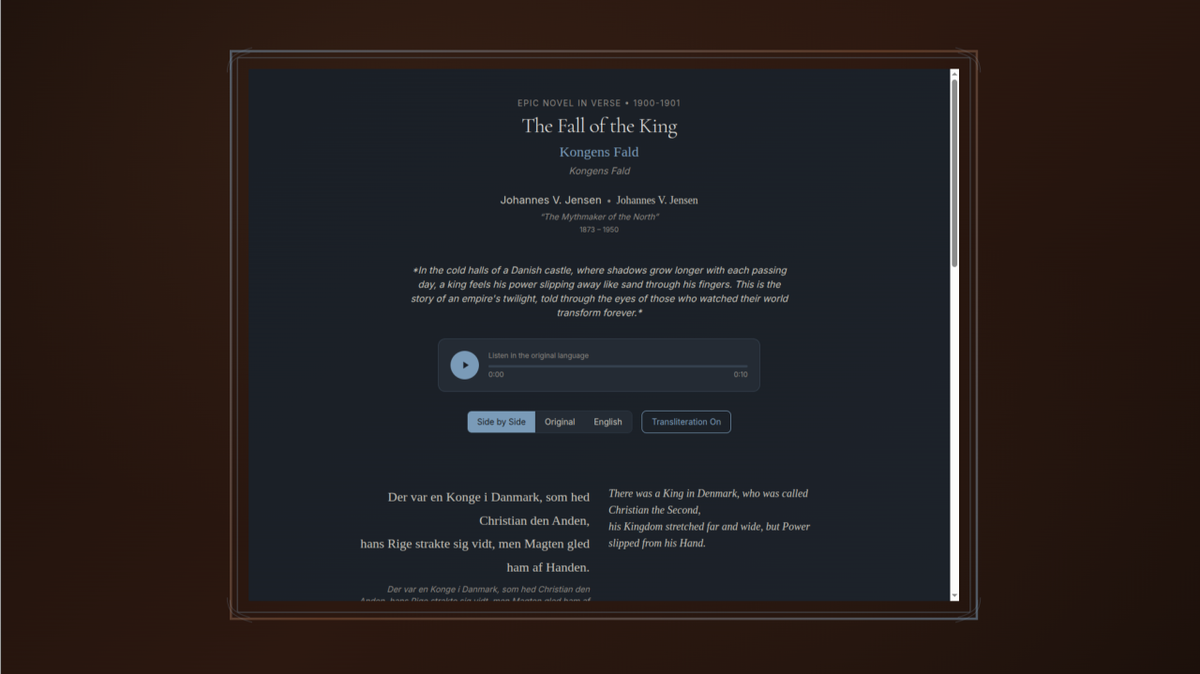
Let me show you what I mean.
I want to share a poem that feels particularly relevant right now - not because it’s ancient or exotic, but because it diagnoses something familiar.
It’s from Denmark. From Johannes V. Jensen, winner of the 1944 Nobel Prize in Literature “for the rare strength and fertility of his poetic imagination.”
The poem is Kongens Fald - The Fall of the King. It opens:
Der var en Konge i Danmark, som hed Christian den Anden, hans Rige strakte sig vidt, men Magten gled ham af Handen.
There was a King in Denmark, who was called Christian the Second, his Kingdom stretched far and wide, but Power slipped from his Hand.
The king sits in his castle, staring out over the water. Below him, the people grumble. The nobility conspire. And then winter comes:
Vinteren kom med sin Kulde, og Sneen faldt tung, som Kongens Tanker, der kredsede, gamle og unge.
Winter came with its Cold, and the Snow fell heavy, like the King’s Thoughts, that circled, old and young.
Jensen was called “the father of Danish modernism.” Critics described his work as “an indictment of Danish indecision and lack of vitality, which he saw as a national disease.”
But that diagnosis isn’t uniquely Danish.
A king who stares while power slips away. Thoughts that circle without resolution. Winter falling heavy while the mind churns through options, old and young, and acts on none of them.
Reading it now - in this moment of geopolitical paralysis, of institutions frozen in hesitation, of leaders staring out windows while conditions deteriorate - Jensen’s poem doesn’t feel like history.
It feels like now.
This is why poetry matters to this project.
A family portrait shows you what people do. The news shows you what they’re facing. But poetry shows you what they believe - about themselves, about fate, about what it means to live well or poorly.
And when you understand what a culture tells itself in its most condensed and careful language, you start to understand why they act the way they do. You see the fears that drive them. The hopes that sustain them. The warnings they’ve encoded into verse so they won’t forget.
The blur sharpens. The abstraction cracks. “Them” starts to sound like people you might actually know.
The poetry layer launches with 21 countries, 103 poets, 378 poems and more coming - Each with the full immersive treatment: original script, audio, annotations, context.
I’d love to know:
- What poems shaped you? What verses live in your head without your permission?
- What cultures should come next? What poetry would help people understand a “them” they’ve been taught to fear?
- What’s missing from this approach?
If this resonates, visit BehindEveryThem.com/poetry and try it yourself.
Behind every “them” is a poem you haven’t heard yet.
Let’s listen.